





A frustrating customer interaction rarely begins with one careless employee. It often starts with a disconnected system, unclear policy, missing customer data, or poorly designed handoff.
I use the service design process for improving customer experience to look beyond visible touchpoints. It connects what customers experience with the people, technology, policies, and workflows operating behind the scenes. That wider view helps teams remove the causes of friction instead of repeatedly treating the symptoms.
Why Customer Experience Problems Begin Behind the Scenes
Customer experience teams often focus on websites, contact centers, stores, emails, and mobile apps. These channels matter, but they represent only the frontstage experience.
The backstage includes approval processes, databases, employee tools, staffing rules, vendors, training, and internal communication. Customers may never see these elements, yet they feel their effects.
For example, a customer may blame a support agent for repeating questions. The real problem could be that the billing and support platforms do not share data. Coaching the agent will not fix that failure.
Service design treats the experience as one connected system. Nielsen Norman Group describes service blueprints as tools that connect customer journeys with the people, processes, and resources required to deliver them.
The Five Stages of an Effective Service Design Process

The service design process for improving customer experience is iterative rather than strictly linear. Teams may return to research after testing or redefine the problem when new evidence appears.
The Design Council’s Double Diamond supports this movement between broad exploration and focused decision-making. Its four phases are Discover, Define, Develop, and Deliver.
1. Research Customers, Employees, and Business Needs
I begin by studying what customers are trying to accomplish, not merely what they say they want.
Customer interviews reveal expectations, emotions, workarounds, and unmet needs. Observation can expose problems customers have stopped mentioning because they consider them unavoidable.
Research must also include frontline employees. They often know where customers become confused and which internal procedures create delays. Their insights can uncover outdated software, duplicated work, unclear ownership, and policies that conflict with customer needs.
The GOV.UK Service Manual recommends researching users throughout service development instead of relying on one large study at the beginning or end.
2. Define the Problem and Map the Current Experience
Research findings need to become a precise service challenge.
A vague objective such as “improve onboarding” gives teams little direction. A stronger problem statement might be: “How might we help first-time customers complete account verification in one session without contacting support?”
I then map the customer’s actions, emotions, questions, channels, and delays. Personas can help when they represent evidence-based customer groups rather than fictional stereotypes.
This stage should identify both visible pain points and their operational causes. Teams learning how to map frontstage and backstage service processes can expose the exact handoffs, systems, and employee actions behind each customer interaction.
3. Generate and Prioritize Service Improvements
Service design works best when design, operations, marketing, technology, customer support, and compliance collaborate.
Co-creation workshops can also include customers and frontline staff. Their involvement prevents senior teams from designing an idealized service that ignores real behavior.
I prioritize ideas using three questions:
Does this change solve an important customer problem? Can the organization deliver it reliably? Will the expected value justify the cost and risk?
One useful method is a friction budget. I assign each pain point a rough score based on customer time, emotional stress, repeat contacts, employee effort, and revenue risk. The highest combined scores become the first candidates for testing.
This approach prevents teams from spending months polishing low-impact touchpoints while serious service failures remain untouched.
4. Prototype the Complete Service Experience
A service prototype should test more than a screen.
Teams can use role-playing, scripts, paper forms, clickable wireframes, mock service counters, automated message samples, or simulated phone calls. The goal is to examine the full sequence, including employee actions and system responses.
A service blueprint is especially useful here. It shows customer actions, frontstage interactions, backstage work, support processes, and physical or digital evidence.
I test the riskiest assumption first. When the proposed service depends on employees completing a task within five minutes, I test that operational requirement before investing in polished interfaces.
5. Implement, Measure, and Improve
A successful prototype is not proof that a service will work at scale.
I prefer a limited pilot with one location, customer segment, or service team. The pilot should include training, process ownership, escalation routes, technical support, and a clear measurement plan.
Implementation also requires updated operating procedures. Employees need to understand what has changed, why it matters, and what to do when the new process fails.
The service design process for improving customer experience continues after launch. Teams should review customer feedback, operational data, accessibility barriers, and employee observations regularly.
The GOV.UK Service Standard likewise emphasizes joined-up channels, multidisciplinary teams, defined success measures, and frequent improvement.
The Service Design Tools That Reveal Hidden Friction
Different tools answer different questions. Using one map for every problem usually creates confusion.
Customer Journey Maps
A customer journey map presents the service from the customer’s perspective. It records stages, actions, channels, emotions, needs, and pain points.
Use it to understand what the customer experiences and where the journey becomes difficult.
Service Blueprints
A service blueprint connects customer interactions with organizational delivery. It reveals employee actions, system dependencies, handoffs, policies, and support processes.
Use it when the journey map identifies a problem but does not explain why it happens.
Stakeholder Ecosystem Maps
An ecosystem map shows the internal and external groups influencing the service. These may include vendors, regulators, delivery partners, payment providers, and internal departments.
Use it when service quality depends on several organizations or decision-makers.
Experience Prototypes
Experience prototypes simulate real service conditions. They help teams observe behavior before committing to a full launch.
Use them to test conversations, waiting periods, environmental cues, digital flows, and employee responses.
A Worked Example: Redesigning Medical Appointment Scheduling
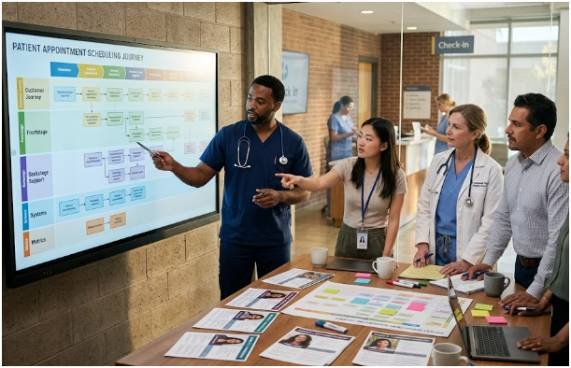
Consider a US healthcare clinic where patients wait three days for appointment confirmation.
The visible problem is a slow scheduling experience. Research reveals several backstage causes. Online requests enter a shared inbox. Staff manually check insurance details. Doctors maintain separate calendars. Patients receive no progress updates.
The team maps the journey and gives the delay a high friction-budget score. It consumes patient time, creates anxiety, generates repeat calls, and increases administrative work.
A prototype introduces one scheduling dashboard, automatic request acknowledgments, standardized insurance checks, and clear escalation rules. The clinic tests it with one department before wider deployment.
The redesign does not merely improve the booking screen. It changes the operating model supporting the screen. That distinction is what makes service design more powerful than surface-level interface improvement.
Measure Customer Experience Without Chasing One Score

No single metric can explain the complete experience.
Customer Satisfaction Score measures satisfaction with a specific interaction. Net Promoter Score indicates stated willingness to recommend. Customer Effort Score measures how easy or difficult customers found a task. These metrics answer different questions.
I combine customer metrics with operational measures such as completion time, abandonment, repeat contacts, error rates, complaint themes, employee handling time, and customer churn.
A scheduling redesign might reduce average completion time while increasing booking errors. Looking only at speed would hide the damage.
The strongest measurement plan connects each metric to the original problem statement.
Common Service Design Mistakes to Avoid
The most common mistake is treating service design as a workshop rather than an operating discipline.
Teams also fail when they map an entire organization at once, rely only on senior stakeholder assumptions, or exclude frontline employees. Some create detailed blueprints but never assign owners to the problems found.
Another mistake is testing only the customer-facing interface. A polished form cannot compensate for an approval process that takes four days.
Start with one meaningful journey, one defined customer group, and one measurable outcome. Expand after the team proves the new service can work reliably.
Frequently Asked Questions
1. How does service design improve customer satisfaction?
It removes the operational causes of delays, confusion, repeated effort, and inconsistent service across customer channels.
2. What is the difference between customer journey mapping and service blueprinting?
A journey map shows the customer’s experience, while a service blueprint connects that experience to employees, processes, systems, and policies.
3. How long does a service design project take?
A focused journey may take several weeks, while complex services involving many departments can require several months of testing and implementation.
4. Which metrics should measure service design success?
Use a balanced mix of CSAT, CES, completion rates, waiting time, repeat contacts, errors, retention, and employee effort.
Your Customer Can See the Cracks—Fix the System
Customers do not care which department owns a broken handoff. They experience the delay, repeat the information, and decide whether the company deserves another chance.
The service design process for improving customer experience gives teams a practical way to repair those cracks. My strongest advice is to choose one high-friction journey and trace it from the customer’s first action to the final backstage dependency.
Do not begin with the prettiest touchpoint. Begin where customers lose the most time, effort, or trust.