



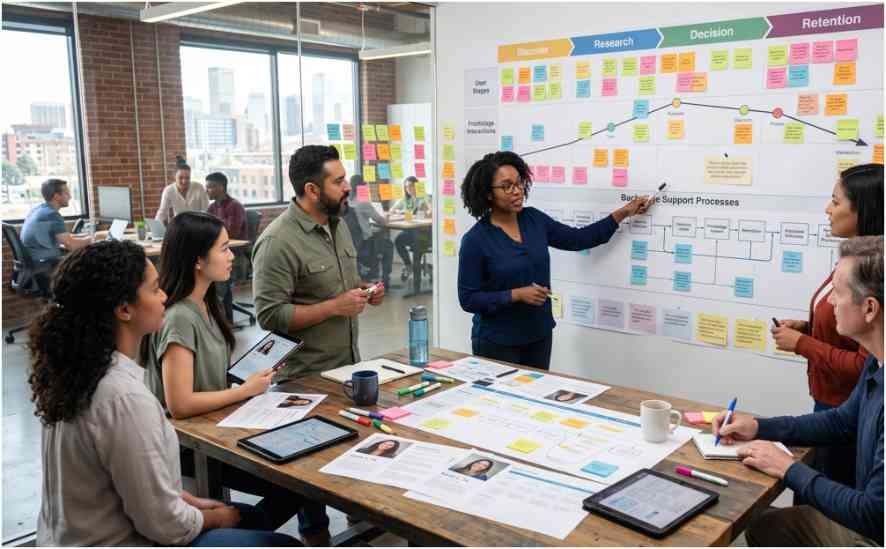
There comes a point in many UX careers when producing stronger wireframes, cleaner prototypes, and more polished interfaces is no longer enough. I reached that point when I realized that the most valuable designer in the room was not always the person with the best screen.
It was often the person who could align a divided team, challenge weak assumptions, connect research to business priorities, and help others do better work.
That shift defines design leadership skills for UX designers. Leadership begins when your influence extends beyond your own deliverables and starts shaping decisions, systems, team culture, and product direction.
Whether you are a senior individual contributor, aspiring design manager, or emerging UX lead, learning how to orchestrate people and strategy can turn strong design ability into organization-wide impact.
What Changes When a UX Designer Becomes a Design Leader?
An individual contributor usually focuses on solving defined user problems through research, flows, prototypes, components, and usability improvements. A design leader operates across a wider system.
The leader determines whether teams are solving the right problems, whether projects support the product roadmap, and whether designers have the people, tools, and organizational support required to succeed. Leadership therefore involves strategic thinking, business translation, team development, resource planning, and cross-functional influence.
UX leadership and UX management also differ. Management includes hiring, performance reviews, workload planning, and administrative responsibilities. Leadership centers on vision, influence, decision quality, culture, and strategic alignment. A principal or staff designer can demonstrate considerable leadership without managing direct reports.
How Do UX Leaders Connect Design With Business Strategy?
Business Translation Turns UX Metrics Into Business Outcomes
Design leaders must explain UX work in language that executives, product managers, marketers, and finance teams understand. Usability scores alone rarely secure organizational support.
I connect design outcomes to conversion rates, customer retention, subscription growth, support-ticket reduction, accessibility risk, operational efficiency, and customer lifetime value. For example, simplifying a confusing onboarding flow may reduce abandonment while lowering the number of customers who contact support.
This does not mean placing business goals above user needs. It means showing decision-makers how a better customer experience can support sustainable commercial results.
Strategic Foresight Creates a North Star Product Vision

Strong UX leaders look beyond the current sprint. They define a long-term North Star vision that explains what the experience should become and how it supports the organization’s larger roadmap.
A useful design vision gives teams direction without prescribing every screen. It clarifies the desired customer outcome, establishes experience principles, and helps teams evaluate short-term compromises.
Without strategic foresight, product squads may deliver disconnected improvements that work individually but produce an inconsistent overall journey.
Systemic Thinking Builds Scalable Customer Experiences
Design leadership requires moving beyond isolated interfaces. Leaders examine how products, channels, services, policies, and internal workflows interact.
Systemic thinking helps teams create scalable design systems, reusable patterns, connected customer journeys, and consistent service experiences. It also reveals upstream problems that interface changes alone cannot solve.
For instance, redesigning a support form may improve usability, but it will not address delays caused by unclear internal ownership. A systemic leader investigates both the customer-facing experience and the operational process behind it.
Resource Optimization Protects Quality Under Constraints
US design teams frequently face limited budgets, hiring restrictions, software expenses, and aggressive release schedules. Design leaders must allocate resources without sacrificing essential research or accessibility standards.
Resource optimization can involve consolidating tools, balancing contractors with full-time employees, prioritizing high-risk research, planning workforce needs, and determining where a design system can reduce repetitive effort.
The goal is not to make designers work faster at any cost. It is to invest time and money where design can create the greatest impact.
How Do UX Leaders Build High-Performing Design Teams?
People Enablement Replaces the “Genius Designer” Model
One of the hardest leadership transitions involves stepping away from being the person who solves everything.
A leader who repeatedly takes over important work may deliver attractive results, but that behavior limits team growth. Effective leaders delegate meaningful ownership, provide context, clarify expectations, and allow designers to develop their own judgment.
As the team grows, a clear design team structure with well-defined roles and responsibilities helps distribute ownership effectively, improve collaboration, and support scalable product development.
I view delegation as a development tool rather than a way to remove tasks from my schedule. The goal is to create capable designers who can make strong decisions without waiting for constant approval.
Constructive Feedback Loops Improve Work Without Creating Fear

Design critiques should maintain high quality standards while protecting psychological safety. Leaders must separate criticism of the work from judgment of the person who created it.
Before a critique, I clarify the customer problem, project stage, known constraints, and type of feedback needed. During the conversation, I encourage participants to explain concerns using evidence rather than personal preference.
Instead of saying, “I do not like this layout,” a reviewer might ask whether the hierarchy helps first-time users identify the primary action. This creates feedback that is specific, respectful, and actionable.
Mentorship Pipelines Scale Design Capability
Informal mentoring helps individuals, but intentional mentorship pipelines strengthen entire organizations. Leaders can pair junior and senior designers, establish development goals, rotate project responsibilities, and create opportunities to practice facilitation or stakeholder presentations.
Career pathing also matters. Designers should understand which skills they need to move toward senior, staff, principal, management, or specialist roles.
A scalable mentoring system reduces dependence on one leader and helps the team build knowledge collectively.
Vulnerability Builds Trust and Psychological Safety
Design leaders do not need to pretend they always have the answer. Healthy vulnerability means acknowledging uncertainty, admitting mistakes, and discussing unsuccessful decisions without assigning blame.
Regular project health checks create space for teams to raise risks before they become emergencies. Leaders can ask what feels unclear, where collaboration is breaking down, and what support people need.
When leaders model low-ego behavior, designers become more willing to challenge assumptions, share unfinished ideas, and learn from failure.
How Can UX Designers Influence Without Formal Authority?
Influence without authority is essential because UX professionals often work across product, engineering, marketing, research, data, and customer-support teams.
Credibility grows when designers prepare carefully, understand technical and commercial constraints, document decisions, and consistently follow through. Leaders also build stronger relationships when they involve partners early rather than presenting polished solutions at the end.
Diplomatic persuasion becomes especially important during ambiguous product stages. Instead of demanding a preferred solution, effective leaders explain the available options, evidence, risks, implementation costs, and likely trade-offs.
Why Do Stakeholder Evangelism and Political Intelligence Matter?

Stakeholder evangelism means communicating research insights and product rationale in accessible language. Design jargon can isolate partners, while clear business and customer language invites participation.
Political intelligence is equally important. Every organization has competing goals, informal influence, limited attention, and moments when leaders are more receptive to change. Understanding that climate helps UX professionals decide when to challenge a decision, when to build additional support, and which user issue deserves immediate escalation.
Political intelligence should not become manipulation. Used responsibly, it helps designers advocate for customers at the moment when advocacy can produce the greatest effect.
UX Designer vs. UX Leader Skill Matrix
| Skill Area | Individual Contributor Focus | Design Leader Focus |
| Primary output | Interfaces, prototypes, flows, and research findings | High-performing teams, strategic frameworks, and design vision |
| Working language | Components, heuristics, usability, and interaction patterns | Revenue, retention, implementation cost, risk, and organizational priorities |
| Problem-solving scope | Specific customer and workflow obstacles | Operational barriers, systemic problems, and alignment failures |
| Success measurement | Quality and effectiveness of personal deliverables | Team capability, customer impact, business outcomes, and strategic influence |
The matrix does not suggest that leaders abandon design craft. Strong craft knowledge builds credibility. However, leadership success increasingly depends on what the team can accomplish without the leader personally controlling every detail.
How Can UX Designers Develop Leadership Skills Before Getting the Title?
Start by solving a leadership problem within your current role. Facilitate a difficult workshop, mentor another designer, improve critique practices, connect research findings to product metrics, or document a shared design principle.
You can also strengthen your business knowledge by learning how your company generates revenue, retains customers, controls costs, and evaluates product performance. Volunteer for roadmap discussions and practice presenting recommendations to non-design audiences.
Specialized programs from organizations such as Nielsen Norman Group and the Interaction Design Foundation can provide additional frameworks, but real growth comes from applying leadership behaviors inside active projects.
Frequently Asked Questions (FAQs)
1. Can a UX designer lead without managing employees?
Yes. Designers can lead through facilitation, mentorship, strategic thinking, research advocacy, process improvement, and cross-functional influence.
2. What is the most important skill for a new UX leader?
The ability to create clarity is critical because it helps teams understand the problem, direction, responsibilities, trade-offs, and measures of success.
3. How should UX leaders measure their success?
They should evaluate team growth, design quality, customer outcomes, stakeholder alignment, delivery effectiveness, and business impact rather than personal output alone.
4. What is the difference between design leadership and senior design work?
Senior designers solve complex design problems, while design leaders also develop people, shape systems, influence strategy, and improve organizational decision-making.
From Individual Craft to Collective Impact
I believe the strongest leaders remain connected to the craft while resisting the urge to control every design decision. They create the conditions in which other people can do their best work.
Mastering design leadership skills for UX designers means learning to translate business priorities, establish a product vision, manage resources, develop talent, navigate organizational dynamics, and advocate for users with credibility.
The real measure of leadership is no longer the number of screens you personally produce. It is the quality, confidence, and lasting impact of the team you help build.