




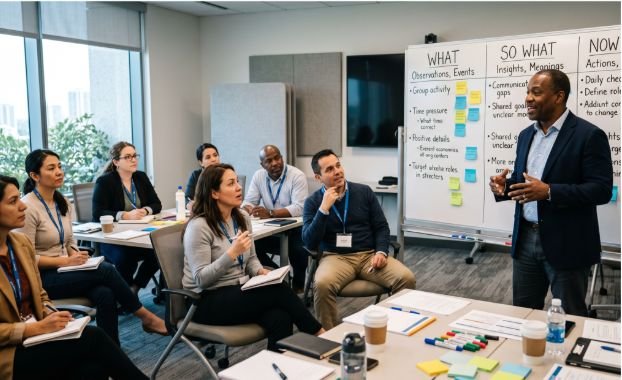
A workshop can feel productive while producing little lasting change. I have found that the difference often appears during the final discussion, when participants either process the experience or rush toward the door.
Effective workshop debriefing techniques for facilitators move a group from describing events to interpreting them and choosing what happens next. The goal is not to collect polite reactions. It is to uncover evidence, surface different perspectives, and convert learning into action.
Why Workshop Debriefs Often Fail
A weak debrief usually begins with, “How did everyone find that?” The question is broad, socially loaded, and easy to answer with silence.
Other debriefs fail because facilitators lecture about the intended lesson. Participants then hear the facilitator’s interpretation instead of forming their own. Some sessions also collect observations without assigning responsibility for improvements.
A debrief should be a directed but open conversation. The Agency for Healthcare Research and Quality describes debriefing as an intentional discussion used to strengthen individual, team, and system performance.
I therefore separate every debrief into three jobs:
- Establish what happened.
- explore why it mattered.
- Decide what will change.
That sequence prevents the loudest opinion from becoming the group’s official conclusion.
Quick Comparison of Workshop Debriefing Methods
| Technique | Best use | Typical time | Main output |
| What? So What? Now What? | Deep reflection after an activity | 15–30 minutes | Lessons and next actions |
| Pluses and Deltas | Rapid process improvement | 8–15 minutes | Strengths and adjustments |
| Start, Stop, Continue, Change | Operational planning | 15–25 minutes | Specific behavior changes |
| Traffic Light Debrief | Energetic or movement-based groups | 10–20 minutes | Keep, stop, and review items |
| Whip Around | Fast inclusion and emotional check-in | 5–10 minutes | One response per participant |
| Circle, Square, Triangle | Dense learning or technical sessions | 10–15 minutes | Curiosities, alignment, fresh insights |
Choose one main method rather than stacking several frameworks. Too many formats can make the closing session feel longer than the workshop itself.
Build the Right Conditions Before Debriefing
Strong workshop debriefing techniques for facilitators begin before the first question.
State the purpose clearly. Explain whether the group is reviewing teamwork, testing a process, evaluating learning, or improving the next workshop. Participants give better feedback when they know how it will be used.
Set ground rules that separate people from problems. Encourage specific examples, allow respectful disagreement, and make passing acceptable during personal reflection rounds.
The CDC recommends establishing ground rules during after-action reviews and considering a neutral facilitator when the subject may be sensitive. It also advises using findings to improve future planning.
I also reserve debriefing time in the published agenda. Treating it as optional almost guarantees that it will be shortened.
Use What? So What? Now What?
This three-stage sequence works because it delays interpretation until the group has established observable facts.
What?
Start with events rather than judgments.
Ask:
- What happened during the activity?
- What did you notice?
- Where did the group change direction?
- What decision affected the result?
“People were disengaged” is an interpretation. “Three people stopped contributing after the voting exercise” is an observation.
So What?
Now explore meaning.
Ask what surprised participants, what patterns appeared, and what helped or blocked progress. Invite competing interpretations instead of forcing agreement too early.
A participant might view silence as confusion. Another may explain that the instructions were clear, but the format favored fast speakers. Both views improve the analysis.
Now What?
Finish with application.
Ask what the group should repeat, test, stop, or adapt. Require actions that can be observed. “Communicate better” is vague. “Send decision criteria 24 hours before the session” is usable.
Fast Debriefing Techniques for Different Groups

No single approach suits every workshop. The best method depends on the group’s energy, trust, available time, and intended outcome.
Pluses and Deltas
Create two sections labeled “Pluses” and “Deltas.” Pluses record practices worth repeating. Deltas describe opportunities for change.
I prefer “delta” to “negative” because it directs attention toward adjustment rather than blame. Ask participants to write independently before sharing. This reduces conformity and gives quieter people time to form their views.
Start, Stop, Continue, Change
Use this framework when the team controls the next steps.
“Start” identifies new practices. “Stop” removes harmful or wasteful behavior. “Continue” protects effective methods. “Change” improves something that still has value.
Push the group toward precise language. Replace “stop having confusing meetings” with “stop opening meetings without a stated decision.”
Traffic Light Debrief
Assign green, red, and yellow zones in the room or on a digital board.
Green represents practices to keep. Red identifies actions to stop. Yellow captures ideas that require conditions, more evidence, or further discussion.
This method works well after an energetic workshop because participants remain physically involved. It also reveals disagreement visually when people choose different zones.
Whip Around
Ask each participant for one word or short phrase. Move around the group without inviting responses to earlier comments.
Use it for an emotional check-in, a key takeaway, or a final commitment. Always allow participants to pass. Forced disclosure undermines psychological safety.
Facilitators working with reserved groups should also plan how to encourage quiet participants during facilitated meetings through writing, pair reflection, anonymous input, and structured turns.
Circle, Square, Triangle
Participants draw three shapes.
Inside the circle, they record an idea still circling in their minds. Inside the square, they note something that fits their existing knowledge. Inside the triangle, they capture a sharp or unexpected insight.
This approach suits training workshops because it distinguishes uncertainty, confirmation, and new learning.
Ask Questions That Produce Useful Evidence
The quality of a debrief rarely exceeds the quality of its prompts.
Avoid closed questions such as, “Did the team communicate well?” Ask, “When did information move effectively, and what made that possible?”
Other useful prompts include:
- What did we expect to happen?
- Where did the actual experience differ?
- Whose needs shaped the decision?
- What information was missing?
- Which behavior should we repeat?
- What would we test differently next time?
The CDC defines an after-action review as a structured discussion that compares what occurred with what participants intended to occur. That comparison is more useful than collecting satisfaction alone.
Use neutral responses after participants answer. “Thank you” or “What do others notice?” keeps the conversation open. Praise such as “Excellent point” can unintentionally rank contributions.
Turn Reflection Into Accountable Action
My most useful addition to common workshop debriefing techniques for facilitators is an Evidence-to-Action Bridge. I place four fields beside every major insight:
| Evidence | Meaning | Next test | Owner and date |
| Only two people spoke during prioritization | The verbal format limited participation | Use silent ranking before discussion | Maya, August 8 |
| Teams interpreted the prompt differently | Instructions lacked a shared example | Show one completed example first | Luis, August 12 |
This structure prevents broad conclusions from floating away after the meeting.
The action should be small enough to test. It should also have one owner, even when several people will help. Close by reading each commitment aloud and confirming when the group will review it.
The CDC’s evaluation guidance emphasizes using findings to support evidence-based decisions and improve program outcomes. A debrief becomes valuable when insight changes a future decision.
Handle Silence, Dominance, and Disagreement

Silence does not always mean participants have nothing to say. They may need processing time, fear consequences, or prefer writing.
Begin with one minute of private reflection. Move to pairs, then invite comments from the full group. This sequence lowers the social risk of speaking.
When one person dominates, introduce equal turns or ask contributors to share one point before returning later. Do not shame an enthusiastic speaker.
When disagreement appears, separate evidence from interpretation. Ask each person what they observed and what assumption connects that observation to their conclusion.
Research summarized by AHRQ identifies psychological safety, leadership, teamwork, and commitment to learning as important conditions for effective debriefing. Participants will not discuss mistakes honestly when the session feels like a performance review.
Frequently Asked Questions
1. What are the best workshop debriefing techniques for facilitators?
What? So What? Now What?, Pluses and Deltas, and Start, Stop, Continue, Change cover most reflection and action-planning needs.
2. How long should a workshop debrief take?
Reserve 10–20% of the workshop for debriefing, with more time after complex or emotionally demanding activities.
3. How do facilitators debrief a quiet group?
Start with silent writing, use pairs, invite structured turns, and allow participants to pass without explanation.
4. What questions should a facilitator ask after a workshop?
Ask what happened, why it mattered, what supported or blocked progress, and what specific action should follow.
The Workshop Is Not Finished Until the Learning Has a Job
I never consider a workshop complete when participants merely say they enjoyed it. A useful ending names what happened, explains why it matters, and assigns the next experiment.
Choose one debriefing framework before your next session. Prepare five open questions, protect the time, and finish with an owner and date for every agreed action. Reflection without follow-through is just an interesting conversation.