




I have seen promising social initiatives lose momentum because the people most affected by the problem were invited to comment only after the solution had already been designed. That approach may produce feedback, but it rarely creates genuine ownership. Co creation in social innovation takes a different path by involving communities, service users, professionals, institutions, and other stakeholders throughout the process.
Rather than assuming that experts hold every answer, co-creation recognizes lived experience as a valuable form of knowledge. It brings different perspectives together to understand complex challenges, develop practical ideas, test possible solutions, and share responsibility for long-term results.
What Co-Creation Means in Social Innovation
Co-creation is a collaborative process in which people affected by a social challenge help define the problem, shape the response, and evaluate the outcome. Participants are not treated merely as research subjects, customers, or workshop attendees. They become active partners in decision-making.
This approach is especially useful when addressing interconnected issues such as unequal access to healthcare, unemployment, educational barriers, housing insecurity, social isolation, or environmental risk. These challenges rarely have one cause or one solution. They require insight from residents, frontline workers, nonprofit organizations, public agencies, researchers, funders, and local businesses.
The purpose is not to make every participant agree. It is to create an environment where different forms of expertise can influence the final direction.
Why Traditional Consultation Is Not Enough
Consultation usually asks people to react to an existing proposal. An organization may distribute a survey, hold a public meeting, or invite comments on a nearly finished program. Although this can uncover useful information, the institution normally retains control over the agenda, budget, priorities, and final decision.
Co-creation begins earlier. Community members help determine which problem deserves attention and what success should look like. They may also participate in research, idea generation, prototyping, delivery, and evaluation.
Using participatory design for community development strengthens this process by giving residents meaningful influence over priorities, proposed solutions, implementation decisions, and measures of success.
The distinction matters because people are more likely to trust, use, and sustain a service when their knowledge has visibly influenced it. Early participation also reveals cultural, financial, physical, or technological barriers that outside teams may overlook.
The Core Principles of Meaningful Co-Creation

Shared Decision-Making
Participants should understand what decisions they can influence. Organizations must clearly explain which elements are flexible, which restrictions cannot be changed, and who has final authority.
Inviting people to contribute while quietly protecting every major decision creates tokenism rather than partnership.
Respect for Lived Experience
Professional credentials are valuable, but they do not replace direct experience. A resident navigating an inaccessible public service may identify problems that administrators, designers, and policymakers cannot see from inside their organizations.
Respect also means compensating participants when possible, scheduling activities at accessible times, covering necessary expenses, and acknowledging their contributions.
Transparency
Partners need honest information about funding, timelines, risks, institutional limitations, data use, and ownership. Transparency helps prevent unrealistic expectations and strengthens accountability.
Inclusion and Accessibility
A diverse room does not automatically create equitable participation. Language, disability, transportation, public transport accessibility for people with disabilities, childcare, digital access, confidence, and previous experiences with institutions can affect who participates and who remains silent.
Facilitators should use multiple participation formats rather than relying entirely on formal meetings or fast-paced workshops.
A Step-by-Step Co-Creation Process

1. Understand the Wider System
Begin by examining the social, economic, cultural, and institutional forces surrounding the challenge. System mapping can reveal relationships between policies, organizations, behaviors, resources, and community conditions.
This prevents teams from treating a visible symptom as the complete problem.
2. Identify the Right Participants
Map everyone who affects or experiences the issue. Include people who are often excluded from formal engagement, not only representatives who already have strong institutional relationships.
Participation should reflect the diversity of experiences within the affected community.
3. Build Trust Before Seeking Ideas
Communities may have experienced abandoned projects, extractive research, or repeated consultation without visible results. Teams must listen before requesting solutions.
Trust grows through consistent communication, realistic promises, accessible information, and small actions that demonstrate reliability.
4. Define the Challenge Together
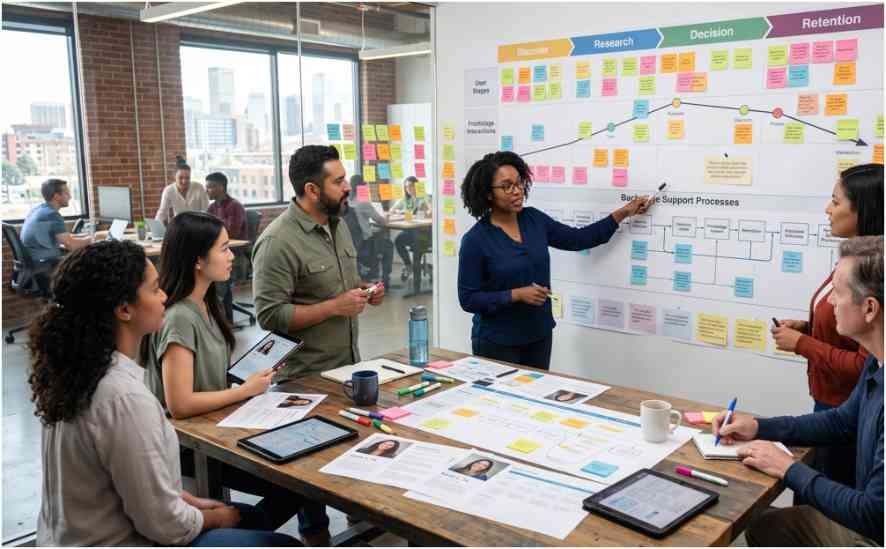
Allow participants to describe the issue in their own terms. Interviews, story circles, observation, journey mapping, and community listening sessions can expose different interpretations of the same experience.
A collaboratively written problem statement creates a stronger foundation than one produced entirely by an external team.
5. Establish Roles and Decision Rights
Clarify who facilitates, approves spending, owns data, chooses ideas, resolves disputes, and communicates progress. Participants should know whether they are advising, designing, delivering, governing, or performing several roles.
6. Generate and Prioritize Ideas
Create space for both familiar improvements and unconventional possibilities. Ideas can then be assessed according to desirability, accessibility, feasibility, cost, equity, and likely impact.
Prioritization criteria should be agreed upon before preferred solutions are selected.
7. Prototype in Realistic Conditions
Turn promising ideas into small, testable versions. A prototype could be a redesigned intake form, a temporary service, a role-played interaction, a neighborhood event, or a simplified digital tool.
Testing early allows teams to discover weaknesses before committing major resources.
8. Implement With Shared Ownership
Community involvement should continue after ideation. Partners can support delivery, train participants, communicate with residents, collect feedback, and adapt the model as conditions change.
Implementation is where co-creation in social innovation becomes more than an engaging workshop exercise.
Practical Methods and Tools

Stakeholder mapping helps teams identify influence, interest, and exclusion. Asset mapping focuses on existing community strengths instead of viewing neighborhoods only through their deficits. Journey mapping reveals what people experience across an entire service, including delays, emotional pressure, and disconnected touchpoints.
Applying human centered design for social innovation helps teams select research, co-creation, and prototyping methods that reflect participants’ real needs, behaviors, and everyday constraints.
Other useful methods include participatory research, listening sessions, service blueprints, story sharing, rapid prototyping, role-playing, community panels, and participatory evaluation.
The best method depends on the participants and the challenge. A visually complex workshop may work for experienced professionals but exclude people with language, literacy, cognitive, or accessibility needs.
How to Measure Co-Created Social Impact
Attendance alone does not prove meaningful participation. Teams should assess who joined, who was missing, whose ideas influenced decisions, and whether participants felt respected.
Implementation measures can include adoption, accessibility, cost, service quality, equity, behavior change, and satisfaction. Longer-term evaluation should examine whether the initiative improved community capacity, strengthened relationships, changed institutional practices, or produced measurable social outcomes.
Teams should also document unintended effects. A program may benefit one group while creating new barriers for another. Continuous evaluation allows partners to adapt instead of protecting the original concept.
Frequently Asked Questions
1. What is co-creation in social innovation?
Co creation in social innovation is a collaborative process in which communities and organizations jointly define social challenges, design responses, test ideas, and evaluate outcomes.
2. How is co-creation different from consultation?
Consultation usually requests feedback on an existing proposal, while co-creation gives participants an earlier and more influential role in framing problems and developing solutions.
3. Who should participate in a co-creation project?
Participants may include affected residents, service users, frontline workers, nonprofits, public agencies, researchers, funders, businesses, and groups that are frequently excluded from decision-making.
4. How can organizations avoid tokenistic participation?
They should clarify decision-making power, involve communities early, remove participation barriers, compensate contributors when possible, and show how community input changed the final outcome.
Moving From Participation to Shared Ownership
I believe the strongest social solutions emerge when institutions stop treating communities as audiences and start recognizing them as partners. Genuine co-creation requires time, trust, transparency, inclusive facilitation, and a willingness to share control.
A workshop alone will not transform a complex system. Lasting change becomes possible when participants influence the entire journey, from defining the challenge to testing the response, measuring its effects, and deciding what happens next. When ownership is genuinely shared, social innovation becomes more practical, more ethical, and more likely to endure.