


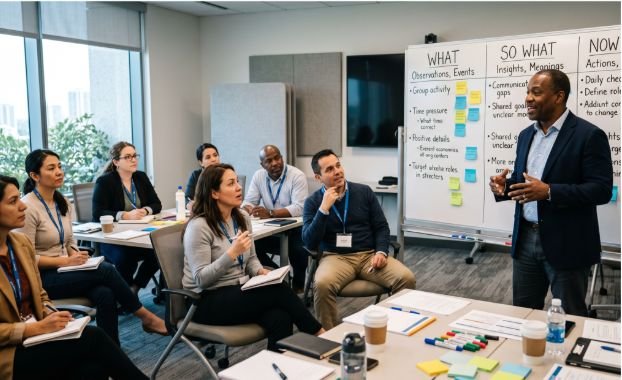


Walking into a quiet conference room filled with blank stares is every meeting leader’s absolute worst nightmare. You gather everyone to solve a massive problem, but the collective energy instantly drops to zero.
Standard corporate approaches often fail because they lack the structure needed to make people feel safe enough to share wild concepts. Transforming these frozen moments requires fresh, engaging brainstorming techniques for teams that turn awkward silence into productive, collaborative energy.
The Secret Sauce: Why Structured Ideation Matters
Let us face the truth: unguided group discussions are where great ideas go to die a slow death. Without intentional facilitation, your loudest coworker dominates the room while brilliant introverts politely check out. Embracing dedicated brainstorming techniques for teams rescues your organization from the soul-crushing boredom of typical corporate groupthink. It injects actual fun into collaborative problem-solving, turning tedious mandatory meetings into high-energy incubators for creative innovation.
Effective facilitation requires a deep understanding of human group dynamics before you ever pick up a dry-erase marker. Most traditional meetings fail because the first idea spoken aloud accidentally sets a rigid boundary for the entire conversation.
Experienced facilitators refer to this common trap as anchoring bias, which quietly crushes creative risk-taking. Creating an environment of psychological safety allows team members to voice unconventional thoughts without fearing immediate criticism from peers.
Setting clear boundaries before the session kicks off keeps the creative momentum moving in the right direction. Your primary objective as a leader is separating the wild generation phase completely from the strict evaluation phase. When people know their contributions will not face immediate judgment, the volume of unique concepts rises dramatically. You must protect this open environment fiercely to ensure your colleagues feel comfortable sharing unfiltered thoughts.
Top Brainstorming Techniques for Teams
Shaking up the physical or digital environment instantly breaks the repetitive patterns of standard corporate meetings. When teams use the exact same format week after week, their collective creative output naturally starts to stagnate.
Introducing structured, non-traditional activities forces the human brain to approach old problems from entirely fresh angles. The following strategies help leaders design engaging experiences that actively maximize group engagement.
The Power of Brainwriting

This specific method completely removes the pressure of public speaking by prioritizing quiet, individual documentation first. Instead of shouting out ideas, team members independently write down their thoughts on sticky notes or a shared digital board before discussing them. This structured process prevents groupthink, bypasses early bias, and gives introverts an equal voice in the room.
The beauty of this framework lies in its unique ability to foster parallel thinking across different departments. Once the initial silent phase wraps up, participants pass their written notes to their neighbors for further elaboration. This rapid cross-pollination ensures that every final concept represents a truly collaborative effort rather than a single perspective.
These collaborative exercises become even more effective when supported by facilitation methods for cross functional teams, helping participants from different departments contribute equally while aligning diverse perspectives toward shared outcomes.
Flipping the Script with Reverse Brainstorming
Reverse brainstorming forces the human mind to solve a tough organizational problem by intentionally figuring out how to cause it. You ask your team to come up with ways to deliberately ruin the exact project, process, or goal you are trying to perfect. Taking the pressure off and listing terrible ideas often unlocks out-of-the-box thinking when you eventually flip them into actionable solutions.
Psychologically, identifying flaws and destructive paths feels much less intimidating to employees than striving for immediate perfection. The team identifies obvious vulnerabilities quickly because thinking about failure triggers a different, more relaxed cognitive pathway. Once you compile a massive list of inverted problems, the facilitation job simply shifts to reversing each item into a stellar defense mechanism.
Six Thinking Hats Perspective Shift

This classic methodology guides your team to evaluate a complex problem from six distinct perspectives sequentially rather than arguing haphazardly.
Participants wear different cognitive caps to analyze facts with white, emotions with red, caution with black, optimism with yellow, creativity with green, and process management with blue. This mental exercise ensures no stone is left unturned during your collaborative analysis.
By forcing the entire room to look through the exact same lens at the exact same time, you eliminate friction. The natural pessimists get their dedicated moment to highlight risks during the black hat phase without bringing down the energy of the creative green hat phase.
It creates a beautifully balanced, multi-layered assessment that traditional open discussions can never replicate.
Starbursting for Question Generation
This approach shifts the focus from generating immediate solutions to generating deep, investigative questions. You place your new project or concept at the center of a literal star design and focus heavily on six core prompts: who, what, when, where, why, and how. Actively questioning the project parameters naturally reveals the exact structural steps needed to make it happen successfully.
Facilitating this technique helps project managers identify hidden hurdles before spending massive budget resources. It prevents the team from falling in love with a flawed solution too early in the development cycle. By the time you finish answering every single generated question, you possess a highly accurate project roadmap.
Rolestorming to Break Mental Barriers
This creative exercise asks team members to brainstorm ideas entirely from the perspective of someone else outside the room. Your participants step into the shoes of a key industry competitor, an end-user, an extreme customer, or even a famous historical figure. Shifting identities removes personal vulnerability, giving people the freedom to voice bold strategies they might normally hide.
When you remove personal ownership from an idea, the fear of workplace judgment completely vanishes. Employees speak with surprising candor when pretending to be an aggressive competitor looking to disrupt the market. This role-playing dynamic brings fresh humor and unprecedented breakthroughs to teams stuck in an ideological rut.
Best Practices for Running a Session
Executing successful brainstorming techniques for teams requires a disciplined roadmap to keep the energy focused.
Starting with virtual icebreakers for meetings can help participants relax, increase early engagement, and create the psychological safety needed for productive brainstorming sessions.
Begin by explicitly framing a single problem statement as an open invitation rather than a rigid command. Spending dedicated effort on setting up the operational guardrails ensures that your creative exercises deliver actionable data instead of chaotic noise.
Set a Strict Time Limit

Using short, rapid-fire sessions like ten to fifteen minutes keeps organizational energy incredibly high and prevents mental exhaustion. When people know the clock is ticking, they naturally stop overthinking and start writing down their raw insights. Tight constraints force the human brain to bypass its internal editor, leading to more authentic and innovative contributions.
As the facilitator, you must hold this timeline boundaries with absolute discipline. Use physical timers or visible digital countdowns to maintain a healthy sense of urgency throughout the room. When the time expires, transition the group immediately to the next phase to keep the momentum rolling forward.
Aim for Quantity Over Quality
In the initial generation phase, focus heavily on producing the largest possible mass of ideas rather than evaluating individual merit. The true magic of collaboration happens when you clear away the obvious, superficial thoughts to reach the deeper creative layers underneath. Remind your team that a high volume of raw concepts provides more raw material to shape later.
Filtering out bad options too early completely derails the creative flow of a workshops session. Encourage your participants to throw every passing thought onto the shared board without second-guessing its viability. You can easily polish, combine, or discard concepts during the downstream curation phase.
Establish Firm Ground Rules
Make sure to defer judgment entirely and enthusiastically encourage wild ideas during the initial ideation phase. Create an ironclad pact that phrases like that will not work or we tried that last year are strictly banned from the room. Your primary role is guarding this judgment-free zone so that every employee feels safe psychologically and be free taking creative risks.
Welcome unusual or borderline absurd suggestions with the exact same enthusiasm as traditional responses. Often, a completely impractical idea serves as the perfect stepping stone for another coworker to build a brilliant, realistic solution. Championing this collaborative building mentality is what separates world-class facilitators from average managers.
Frequently Asked Questions
1. What is the best brainstorming method for teams?
The best method depends on your team setup, but brainwriting stands out as incredibly effective. This technique allows quiet introverts and remote workers to share insights through writing, ensuring dominant personalities do not hijack the conversation.
2. What are the 5 methods of brainstorming?
Five powerful methods are brainwriting for silent generation, reverse brainstorming for problem flipping, six thinking hats for perspective shifting, starbursting for deep questioning, and rolestorming for identity-based creative roleplay.
3. How to do brainstorming on teams?
To implement successful brainstorming techniques for teams, establish absolute psychological safety, set strict time constraints, leverage visual digital boards, focus completely on high quantity, and utilize structured voting methods to pick winners.
4. What are the four brainstorming techniques?
The four foundational pillars consist of deferring all immediate judgment, prioritizing sheer idea quantity, actively welcoming wild concepts, and deliberately combining separate thoughts to build entirely new, multi-layered workplace solutions.
Say Goodbye to Boring Meetings Forever
Transforming how your organization handles collaborative problem-solving requires moving far beyond basic, unstructured open discussions. Embracing intentional facilitation frameworks allows you to capture brilliant insights that usually get lost in everyday workplace noise.
Choose one structured method for your upcoming meeting, establish clear operational rules, and watch your team’s collective creative confidence skyrocket.