



Customers do not experience departments, software platforms, or internal reporting lines. They experience one journey. When that journey breaks between a website, call center, email, or physical location, they blame the organization rather than the handoff.
Learning how to design an end to end service experience means connecting every visible interaction with the people, rules, data, and technology behind it. I have found that the strongest services preserve four things throughout the journey: customer intent, information, progress, and ownership.
What an End-to-End Service Experience Includes
An end-to-end experience begins when a customer recognizes a need. It continues through research, purchase, use, support, renewal, or departure.
The journey may include advertisements, search results, websites, mobile apps, employees, invoices, delivery partners, and support channels. Each interaction must help the customer move toward one meaningful outcome.
Service design therefore goes beyond improving individual screens. It examines how separate parts work together. The Government Digital Service describes service design as fitting multiple pieces together so they meet user needs as one complete service.
End-to-End Service Design at a Glance
| Stage | Main activity | Practical output |
| Research | Understand customer needs and operational limits | Research findings and touchpoint inventory |
| Define | Map the current journey and locate friction | Current-state journey map |
| Develop | Co-create improvements across teams | Future-state service blueprint |
| Test | Prototype interactions and handoffs | Tested service scenarios |
| Deliver | Assign ownership and monitor outcomes | Operating plan and measurement framework |
The process resembles the Design Council’s Double Diamond. Teams first explore the problem broadly, define it, develop possible solutions, and then deliver tested improvements.
Step 1: Define the Customer and Their Desired Outcome
Select One Primary Customer
Start with one customer group rather than trying to design for everyone. Choose a group with a specific need, context, and level of knowledge.
For example, “patients” is too broad. “A first-time patient trying to book an urgent appointment without calling during work” provides a clearer design focus.
A narrow starting point does not make the final service exclusive. It gives the team enough clarity to examine real behavior before addressing additional customer groups.
Frame the Journey Around an Outcome
Define what the customer wants to accomplish, not what your organization wants them to complete.
“Submit an application” describes a transaction. “Receive approval to open a business” describes the full outcome. This distinction prevents teams from optimizing one form while ignoring everything customers must do before and after it.
Step 2: Research the Current Service Experience
Interview Customers and Frontline Employees
Speak with customers who recently completed, abandoned, or struggled with the service. Ask them to reconstruct what happened in chronological order.
Avoid asking whether they liked the experience. Ask what they expected, what they did next, where they hesitated, and how they recovered.
Frontline employees provide a second source of evidence. They know which policies confuse customers, which workarounds happen daily, and which systems fail during unusual cases.
Audit Every Customer Touchpoint
List every place where customers receive information or take action. Include webpages, forms, email messages, text alerts, calls, invoices, physical locations, and third-party services.
Record the owner, channel, purpose, data collected, and next step for each touchpoint. This audit often reveals duplicated forms, conflicting instructions, and interactions that no team actively manages.
Step 3: Map the Current Customer Journey
Record Actions, Thoughts, and Emotions
Create a chronological map from the moment the need appears until the customer achieves the outcome or leaves.
For each stage, capture:
- What the customer does
- What they are trying to understand
- How they feel
- Which channel they use
- What prevents progress
Experience maps are designed to show what users do, think, and feel from the beginning to the end of a service need.
Identify Friction and Service Delivery Gaps
Look for repeated information requests, unclear next steps, long waits, failed transfers, conflicting policies, and inaccessible channels.
This is also the right point to examine how to identify service delivery gaps. Compare what customers expect with what the organization consistently delivers.
I use four diagnostic questions at every transition:
- Does the next channel know the customer’s intent?
- Does relevant information move with the customer?
- Is completed progress preserved?
- Does someone own the next action?
Any “no” answer identifies a continuity break.
Step 4: Build a Frontstage and Backstage Service Blueprint

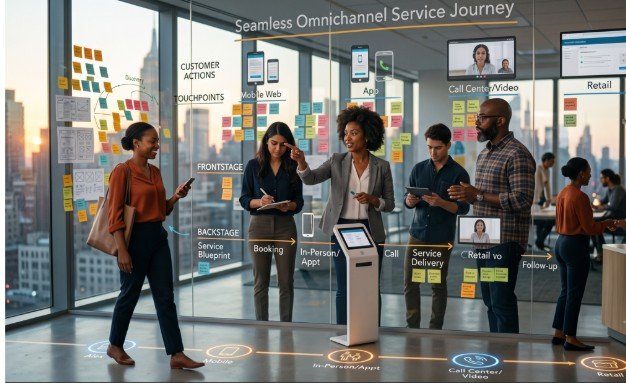
Map Visible Customer Interactions
Place the customer journey across the top of the blueprint. Beneath it, document every frontstage interaction that customers can see.
Frontstage actions may include a receptionist confirming an appointment, an app displaying an order status, or an agent explaining a billing charge.
Connect Supporting Processes and Systems
Below the frontstage layer, map backstage work. Include internal reviews, automated notifications, inventory checks, employee decisions, databases, vendors, and approval rules.
A journey map represents the user’s experience. A service blueprint shows the processes required to produce that experience.
Connect each customer touchpoint to its supporting process. Then mark system dependencies, delays, failure risks, and team handoffs.
A useful blueprint covers the service from front to back and across every channel.
Step 5: Design a Connected Omnichannel Experience
Make Customer Context Travel
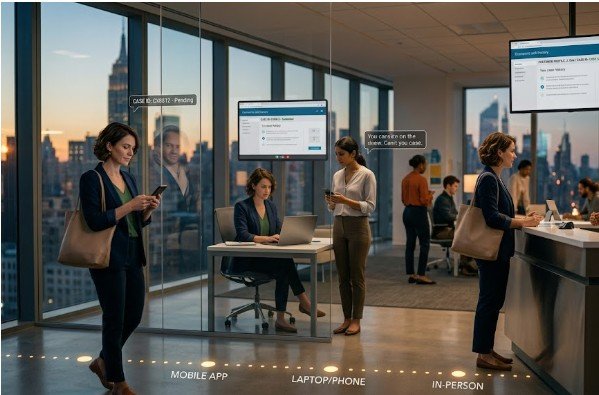
Customers should not need to restart when switching channels. Preserve their identity, previous actions, submitted information, preferences, and current status.
For example, a customer who starts an insurance claim online should be able to call an agent without repeating the incident details. The agent should see what has been completed and what remains unresolved.
This does not require every channel to offer identical functions. It requires each channel to recognize the same customer journey.
Standardize the Experience Without Removing Flexibility
Use consistent language, eligibility rules, status labels, and service expectations across channels.
However, avoid forcing every customer through one rigid path. Employees need clear exception rules for accessibility needs, complex cases, payment difficulties, and urgent situations.
Consistency creates trust. Controlled flexibility prevents the service from failing customers whose needs do not fit the default process.
Step 6: Prototype the Complete Service

Test Moments, Transitions, and Recovery Paths
When deciding how to design an end to end service experience, do not prototype only the digital interface. Prototype emails, conversations, handoffs, delays, and failure responses.
Build low-cost versions first. Use paper forms, clickable screens, scripted calls, sample notifications, and role-played employee interactions.
Test the happy path, but also test realistic disruptions. What happens when payment fails? What happens when the appointment changes? What happens when the customer cannot provide a standard document?
Run a Service Safari
Ask team members to experience the service as customers. They should search for information, complete forms, call support, visit locations, and follow all instructions.
A service safari exposes practical issues that workshop discussions miss. These may include unclear signs, mobile forms that lose data, long call menus, or emails that do not explain the next step.
Observe the complete journey rather than evaluating each channel separately.
Step 7: Assign Ownership and Delivery Metrics
Give Every Handoff an Owner
A seamless design will still fail when nobody owns cross-team transitions.
Assign an owner to every critical handoff. Define what information must transfer, how quickly the next action should occur, and what triggers escalation.
Ownership should follow the customer problem. It should not end when one department completes its internal task.
Measure Outcomes Instead of Activity
Track whether customers achieve their goals efficiently and confidently.
Useful measures include completion rate, time to outcome, repeat contact rate, abandonment, first-contact resolution, customer effort, error recovery, and successful channel transitions.
Pair customer measures with operational measures. A slow approval may result from an internal queue rather than a poor interface.
A Worked End-to-End Service Design Example
Consider a medical clinic redesigning appointment booking.
Research shows that patients can request appointments online. However, they must call to confirm insurance details. The phone agent cannot see the original request, so patients repeat their symptoms and preferred times.
The journey map reveals frustration during the channel switch. The blueprint shows that the website and call-center systems do not share records.
The team creates one case number at the start. It transfers the request, insurance status, contact preference, and scheduling progress across channels. Patients receive a clear message when staff action is required.
The improvement is not a prettier booking page. It is continuity between customer intent, data, progress, and operational ownership.
Common End-to-End Service Design Mistakes
The most common mistake is starting with an assumed solution. Teams may redesign an app before confirming whether the app causes the problem.
Another mistake is mapping only the ideal journey. Real services contain missed payments, incomplete records, exceptions, delays, and accessibility needs.
Teams also create impressive blueprints that never influence delivery. Keep the map connected to owners, priorities, prototypes, and measurable changes.
Finally, avoid treating launch as the finish line. Services change when policies, customer behavior, staffing, and technology change. Review the journey regularly and update the blueprint when evidence shifts.
Your Service Is Only as Smooth as Its Messiest Handoff
Knowing how to design an end to end service experience changes the design question. Instead of asking whether each touchpoint works, ask whether the entire journey helps customers reach their goal.
Start with one customer, one outcome, and one current journey. Test the transitions before polishing individual channels. The weakest handoff often creates more friction than the most visible interface.
Frequently Asked Questions
1. What is an end-to-end service experience?
It is the complete customer journey from the first need through purchase, delivery, support, retention, or departure.
2. How do you map an end-to-end customer journey?
Research real behavior, arrange customer actions chronologically, record emotions and channels, then connect each step to supporting operations.
3. What is the difference between a journey map and a service blueprint?
A journey map shows the customer’s experience, while a service blueprint connects that experience to employees, processes, systems, and policies.
4. How do you improve handoffs between service channels?
Preserve customer context, define required information, assign an owner, set response expectations, and test how the transition works during failures.